History of 7¼" Gauge

Typically miniature railways have a rail track gauge between 5" (127mm) and 18" (457mm), though both larger and smaller gauges are used.
The major distinction between a miniature railway and a narrow gauge railway is that miniature lines use models of full sized prototypes. There are miniature railways
that run on gauges as wide as the 2ft 6" (762mm) gauge on the defunct Disneyland Viewliner, or as wide as the 2ft (610mm) gauge on the operating Wickstead Park Railway. There are also narrow gauge railways
running on extremely narrow track as small as 15" (381mm) gauge or less, for example the Rudyard Lake Steam Railway, Perrygrove Railway and the Eaton Hall Railway. These are known as minimum gauge railways.
At gauges of 5" (127mm) and less, the track is commonly raised above ground level. Flat cars are arranged with foot boards so that driver and passengers sit astride
the track. The track is often multi-gauged, to accommodate 5" (127 mm), 3½" (89mm), and sometimes 2½" in (64mm) gauge locomotives.
Background
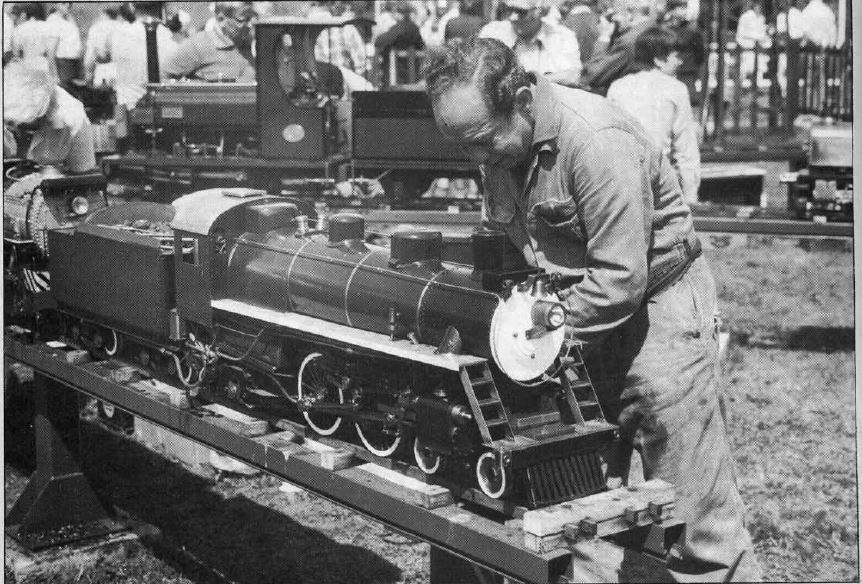
There is no doubt that modelling locomotives is the side of the hobby that creates the greatest interest. Making models of railway engines has been going on ever since
the first full size locomotives were themselves produced. Some of the old models were very fine indeed, others were, to say the least, somewhat crude.
Over the years the interest in modelling locomotives has steadily increased, although there has been quite a change in the sizes of the models being built. Gauges have,
in particular, been the main subject of change and the old 2" gauge, for example, is virtually extinct.
Let us first of all look at gauges - to which, of course, is related scale - and see what can be done. The first question is where does railway modelling end and model
engineering begin? The answer is that there is no clear dividing line. Engineers have successfully built fully complete steam locomotives in 'N' gauge, which is 9 mm between the rails. However the smallest
at which steam really becomes practical is that of gauge 'HO' and, whilst this is usually the gauge used for electrically driven models, there are those who build steam locomotives in that size,
particularly on the continent.
The next frequently seen gauge for steam locomotive construction is 'O' and here we start to see fine model engineering at its very best in locomotives of true scale
proportions, some of which are even coal fired.
From here we move up to "Gauge One" which is a veritable bastion of steam locomotives and in which we see some particularly fine models. The 'Gauge One Association'
has even produced a simple basic design which can be done by the novice. The advantage of both these two gauges is the fact that one does not need a massive workshop and lots of equipment to build the
locomotives and, when completed, they can be kept on the mantelpiece for all to see, or run in a comparatively small garden for the pleasure of seeing them operate. A more recent development in bot these
gauges has been that of radio control of such models.
2½" gauge
As we come to the 2½" gauge then we start to approach the sort of locomotives that can be used to haul passengers. Even quite a small locomotive in this scale
will haul at least the driver and probably a couple of adults as well. Whilst not as popular as it used to be, the gauge still has plenty of devotees. MAny years ago it was one of the most popular, one
reason for this being that there were few club tracks available for the running, and a small track could be built in the garden. If one did want to want to take the locomotive to someone else's track
then a trailer on a cycle would be a good means of transporting it. Remember, very few people had cars in those days when petrol was less than 1/ - or 5 pence a gallon!
The gauge again allows for locomotive construction with a minimum of equipment and models are easy to store. Also, of course, the smaller the locomotive then the
less it costs to build.
3½" gauge
3½" gauge has always been highly popular and still is. The locomotives can haul quite a heavy load and are ideal for passenger hauling whilst again having the
advantage of being not as expensive as those in the larger gauges and needing lighter equipment for construction. There are very many fine designs available in this gauge.
Whether or not 5" gauge has overtaken 3½" in popularity is open to question. Certainly the locomotives can haul very heavy loads and it has been known for some
large models to haul as many as eighty people. The gauge is quite practical for the home modeller with a large number of designs available. Quite a modest sized lathe plus hand tools are all that is
really required.
7¼" gauge
7¼" is now very popular but still probably somewhat heavier than most people want to cope with. There is naturally a tendency to model small prototypes.
The gauge is very practical for passenger hauling on ground level tracks and the smaller locomotives can be constructed with fairly modest equipment. Providing the models do not have to be stored in
the loft when not in use, the construction of a locomotive in the gauge is a most interesting prospect.